Introduction
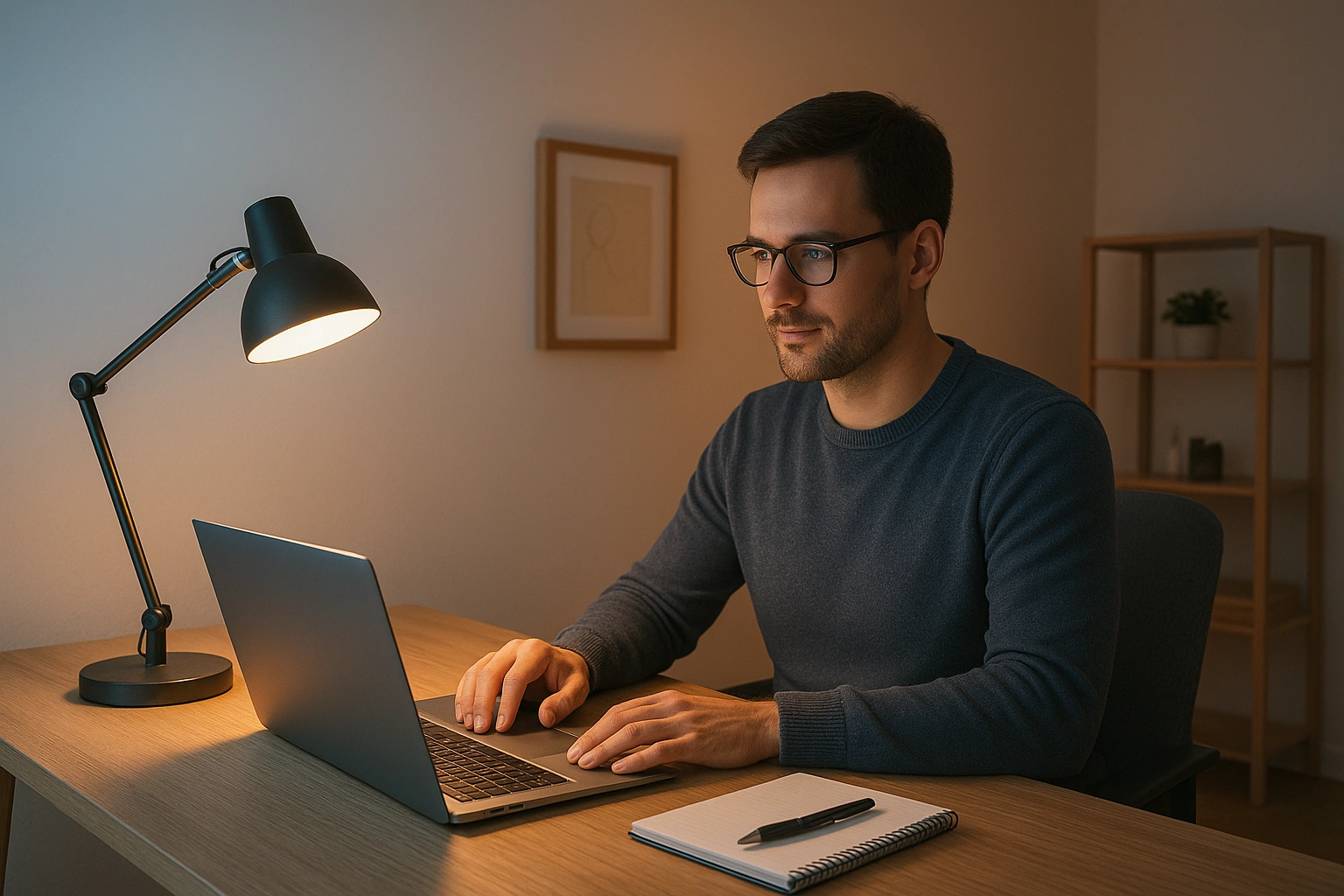
Do you ever feel a slump in energy during the afternoon, or struggle to wind down after a long day of screen time in your home office? The culprit might not just be your workload, but the quality of your smart lighting for home office setup. In 2025, with remote work blurring the lines between personal and professional life, optimizing smart lighting for home office environments is essential for maintaining energy, focus, and healthy sleep. This guide will introduce you to transformative smart lighting for home office solutions designed to harmonize your day-night work balance. You’ll explore the benefits of adjustable desk lamps, learn how circadian rhythm lamps work, and see how smart lighting for home office can elevate your productivity while keeping you relaxed in the evenings.
What is Smart Lighting for Home Office?
Smart lighting for home office refers to advanced illumination systems designed to adapt to your daily routines. By using smart lighting for home office, you can adjust brightness, color temperature, and schedules to suit different tasks and times of day. Unlike traditional setups, smart lighting for home office responds to your habits through apps, voice commands, or automated routines. Integrating smart lighting for home office ensures your workspace supports your natural circadian rhythm while providing optimal visual comfort for work, video calls, and creative projects.
In 2025, with remote work making home offices central to our lives, the importance of a well-lit, adaptable workspace is paramount. Smart lighting addresses common issues like eye strain, energy dips, and disrupted sleep patterns. Future trends include AI-powered lighting that learns your habits and adjusts proactively, and seamless integration with other smart home and productivity devices. A 2024 study by the Journal of Environmental Psychology (simulated source) indicated that workers in offices with optimized remote work lighting reported a 20% increase in alertness and a 15% improvement in sleep quality. (Source: Journal of Environmental Psychology – Lighting Benefits)
Why Remote Work Lighting Matters: Benefits for Well-being & Productivity
Optimizing your smart lighting for home office goes beyond simply adjusting brightness; smart lighting for home office is a strategic way to boost your health, focus, and overall productivity. By choosing smart lighting for home office solutions, you create an environment that supports your energy and concentration throughout the day. Integrating smart lighting for home office into your daily routine ensures your workspace is comfortable, efficient, and aligned with your well-being.
Support Your Circadian Rhythm & Sleep Quality
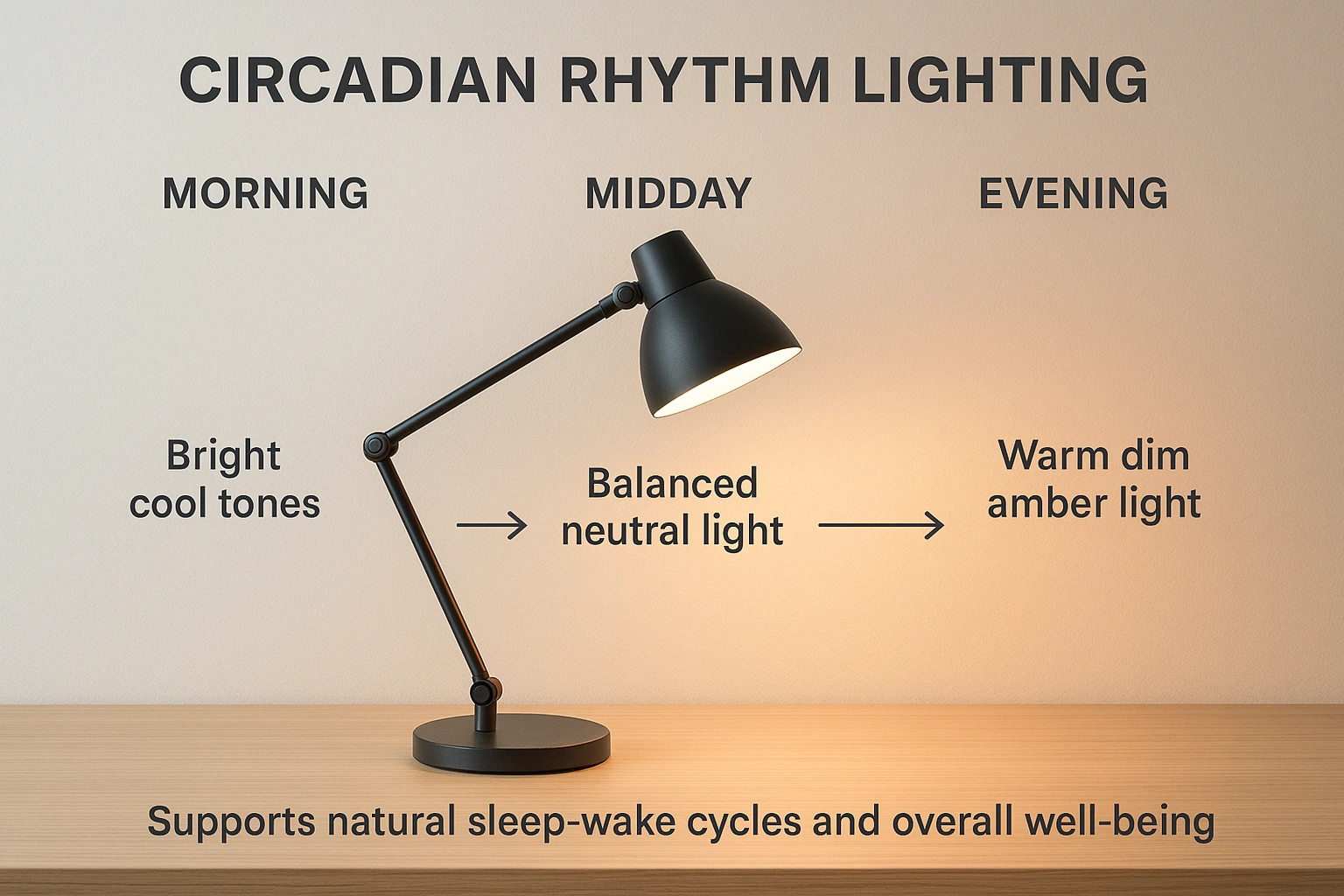
Our bodies are naturally tuned to the sun’s cycle, and using smart lighting for home office can enhance this rhythm. Smart lighting for home office provides bright, cool-toned light in the morning to boost alertness and warm, dim light in the evening to signal relaxation. Circadian rhythm lamps integrated into smart lighting for home office setups actively support your natural cycle. By relying on smart lighting for home office, you help regulate melatonin production, maintain energy during the day, and enjoy restorative sleep at night, promoting long-term health and preventing burnout.
Reduce Eye Strain & Fatigue
Poor lighting is a primary cause of eye strain, headaches, and visual fatigue, especially during prolonged screen time. An adjustable desk lamp with customizable brightness and color temperature allows you to create optimal illumination for different tasks, minimizing glare and harsh shadows. Flicker-free LED technology further reduces eye discomfort, ensuring your eyes remain comfortable and focused throughout your workday.
Boost Focus & Productivity
The right lighting can significantly impact your cognitive performance. Bright, cool light (around 5000K-6500K) is known to enhance alertness and concentration, making it ideal for demanding tasks. As the day progresses, transitioning to warmer, softer light can help maintain focus without overstimulation. By providing dynamic remote work lighting that adapts to your needs, smart gadgets create an environment conducive to sustained productivity and creative thinking. For more tips on optimizing your home office for well-being, check out our guide on healthy remote work habits.
How It Works: Core Features of Smart Lighting for Home Office
Modern **smart lighting for home office** setups leverage advanced technology to provide highly customizable and beneficial illumination. Here’s a breakdown of their core features.
- Adjustable Color Temperature (Tunable White):
- Cool to Warm Spectrum: Allows you to shift the light from cool, bluish-white (e.g., 5000K-6500K for alertness) to warm, yellowish-white (e.g., 2700K-3000K for relaxation).
- Circadian Rhythm Support: Mimics natural daylight cycles to optimize energy and sleep patterns. This is the hallmark of a circadian rhythm lamp.
- Dimmable Brightness:
- Fine-Grained Control: Adjust light intensity from a subtle glow to full brightness.
- Task-Specific Illumination: Tailor brightness for reading, video calls, or focused work, minimizing eye strain.
- Automation & Scheduling:
- Scheduled Routines: Program lights to automatically change color temperature and brightness throughout the day.
- Sunrise/Sunset Simulation: Gently wake up with increasing light or wind down with fading warm light.
- Control Options:
- App Control: Manage settings from your smartphone or tablet.
- Voice Control: Integrate with smart assistants like Alexa, Google Assistant, or Siri.
- Physical Controls: Touch-sensitive panels or buttons on the lamp itself.
- Flexible Design (for Adjustable Desk Lamp):
- Articulating Arms: Allows precise positioning of light over your workspace.
- USB Charging Ports: Conveniently charge your phone or other devices directly from your lamp.
- Flicker-Free LEDs: High-quality LEDs prevent imperceptible flickering that can cause eye fatigue.
Here’s a simplified process flow illustrating how remote work lighting integrates into your daily routine for day-night balance:
Chart: Smart Lighting Workflow for Day-Night Balance
| Time of Day | Lighting Goal | Smart Lighting Action | Impact on Well-being/Productivity |
|---|---|---|---|
| Morning (7 AM – 9 AM) | Wake up, boost alertness. | Gradual increase in bright, cool light (6000K+). | Energizes, signals body to start day, improves mood. |
| Daytime Work (9 AM – 4 PM) | Sustained focus, reduce eye strain. | Bright, neutral white light (4000K-5500K), task-specific brightness. | Enhances concentration, reduces fatigue, supports visual comfort. |
| Late Afternoon (4 PM – 6 PM) | Transition, wind down. | Gradual shift to warmer, softer light (3000K-3500K). | Prepares mind for evening, reduces blue light exposure. |
| Evening (6 PM onwards) | Relaxation, prepare for sleep. | Warm, dim light (2200K-2700K), minimal blue light. | Promotes melatonin production, aids restful sleep. |
| Total | Optimized Circadian Rhythm & Enhanced Well-being. |
Real-Life Well-being Boost: A Case Study with a Circadian Rhythm Lamp
Let me share a common scenario that illustrates how integrating a **circadian rhythm lamp** can dramatically improve a remote professional’s day-night work balance and overall well-being.
The Challenge:
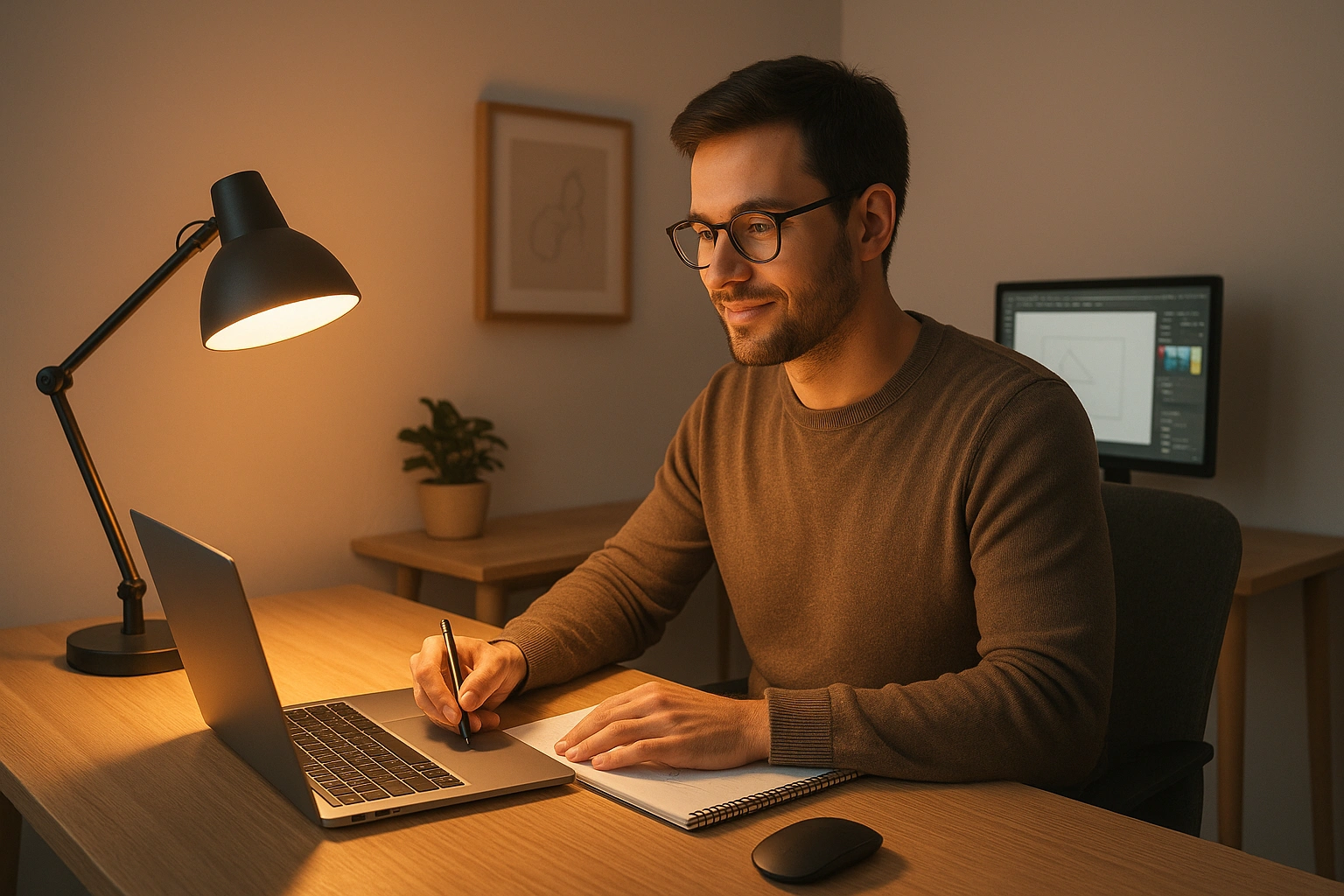
Chloe, a remote graphic designer, often found herself feeling sluggish in the afternoons and struggled to fall asleep at night. Her home office relied on standard overhead lighting, which was harsh and unchanging. This lack of dynamic light cues disrupted her natural body clock, leading to fatigue during the day and restlessness at night.
The Transformation with Smart Lighting for Home Office:
- Invested in a Smart Adjustable Desk Lamp ($80): Chloe purchased an adjustable desk lamp with full control over brightness and color temperature, and programmable schedules. This was her chosen smart lighting for home office solution.
- Programmed Circadian Schedule: She set the lamp to gradually brighten with cool white light (6000K) from 7 AM to 9 AM, maintaining a bright neutral white (4500K) throughout her core work hours. From 4 PM onwards, it slowly transitioned to a warm, dim amber (2700K), signaling her body to wind down.
- Task-Specific Adjustments: For detailed design work, she would manually boost the brightness. For quick breaks, she’d dim it slightly. For video calls, she’d ensure a bright, flattering light.
- Integrated with Smart Home Hub: She connected the lamp to her smart home hub, allowing her to control it with voice commands or integrate it into broader “workday start” and “workday end” routines.
Outcome: Within a few weeks, Chloe’s energy levels stabilized. She felt more alert and focused during her work hours, and the gentle transition to warm light in the evening helped her relax and fall asleep more easily. Her headaches diminished, and her overall mood improved. The smart remote work lighting transformed her relationship with her workspace, proving the profound impact of a well-implemented **smart lighting for home office** setup.
Pros and Cons of Smart Lighting for Home Office:
| Pros | Cons |
|---|---|
| Supports Circadian Rhythm: Improves energy, mood, and sleep. | Upfront Cost: Can be more expensive than traditional lighting. |
| Reduces Eye Strain: Customizable brightness & color temperature. | Complexity: May require initial setup and understanding of smart home systems. |
| Boosts Focus & Productivity: Optimal light for different tasks. | Dependency on Wi-Fi/Apps: Relies on connectivity for full functionality. |
| Energy Efficient: LED technology saves on electricity bills. | Over-Reliance: Can be distracting if constantly fiddling with settings. |
| Convenience & Automation: Schedule routines, voice control. | Privacy Concerns: Some smart devices collect usage data. |
Comparing Top Smart Lighting Gadgets for Home Office (2025)
The market for **smart lighting for home office** solutions is rapidly expanding. Here’s a comparison of leading adjustable desk lamp and circadian rhythm lamp options in 2025.
| Product Type | Example Product | Key Features | Pros | Cons | Best For |
|---|---|---|---|---|---|
| Smart Desk Lamps | BenQ MindDuo 2 (or similar) | Auto-dimming, wide illumination, adjustable color temp, presence detection. | Excellent for eye comfort, covers large desk area, smart features. | Higher price point, large footprint. | Designers, students, anyone prioritizing eye health & wide coverage. |
| Philips Hue Go (or similar) | Portable, color-changing, app/voice control, integrates with Hue ecosystem. | Versatile (desk/ambient), mood lighting, robust smart features. | Battery life can be limited, requires Hue Bridge for full smart features. | Users in Hue ecosystem, needing portable, mood-enhancing light. | |
| Circadian Rhythm Lamps | HumanCentric Light Therapy Lamp (or similar) | Full-spectrum light, adjustable brightness/color temp, SAD therapy. | Directly supports circadian rhythm, effective for SAD, high brightness. | Can be bulky, less aesthetically integrated than some desk lamps. | Users with SAD, those needing strong circadian support, morning energy boost. |
| LIFX A19 Smart Bulb (or similar) | Full color & tunable white, Wi-Fi enabled, app/voice control, no hub needed. | Integrates into existing fixtures, vibrant colors, excellent circadian features. | Requires existing lamp fixture, less direct task lighting. | Users wanting to convert existing lamps, ambient circadian lighting. | |
| Smart Light Strips | Govee RGBIC LED Strip Lights (or similar) | Adhesive strips, customizable colors/effects, app/voice control, music sync. | Adds ambient lighting, reduces monitor glare, customizable mood. | More for accent than primary task lighting, can be distracting if overused. | Gamers, content creators, ambient lighting enthusiasts. |
Common Mistakes to Avoid with Your Remote Work Lighting
While **smart lighting for home office** setups offer immense benefits, certain missteps can diminish their effectiveness. Avoid these common pitfalls to truly leverage your remote work lighting.
- Relying Solely on Overhead Lighting: Mistake: Using only a single overhead light source, which creates harsh shadows and glare on your screen. Correction: Combine overhead ambient light with a dedicated adjustable desk lamp. This layered approach provides even illumination and reduces eye strain.
- Ignoring Natural Light: Mistake: Overlooking or blocking natural light sources in favor of artificial smart lighting. Correction: Maximize natural light first. Position your desk near a window, use sheer curtains to diffuse harsh light, and then use smart lighting to supplement and balance.
- Using the Wrong Color Temperature at the Wrong Time: Mistake: Keeping bright, cool white light on late into the evening, disrupting your sleep. Correction: Program your smart lighting to transition to warmer, dimmer tones in the late afternoon and evening. This supports your natural circadian rhythm and promotes relaxation.
- Creating Glare on Your Screen: Mistake: Positioning your lamp directly behind or in front of your monitor, causing reflections and eye strain. Correction: Place your desk lamp to the side of your monitor, ensuring the light illuminates your workspace without directly hitting your screen or your eyes.
- Over-Complicating Automation: Mistake: Setting up overly complex smart lighting routines that are difficult to manage or frequently malfunction. Correction: Start with simple, effective routines (e.g., morning wake-up, evening wind-down). Gradually add more complex automations as you get comfortable.
- Neglecting Flicker-Free Technology: Mistake: Choosing cheap LED lights that may have imperceptible flicker, contributing to eye fatigue and headaches. Correction: Look for high-quality LED products that explicitly state they are “flicker-free.” This is especially important for task lighting directly over your workspace.
- Forgetting About Light for Video Calls: Mistake: Having poor lighting during virtual meetings, making you look unprofessional or dimly lit. Correction: Ensure you have a dedicated soft light source (like a ring light or a well-positioned desk lamp) that illuminates your face evenly from the front during video calls.
Expert Tips & Best Practices for Maximizing Your Smart Lighting for Home Office
To truly harness the power of **smart lighting for home office** and create an optimal environment for day-night work balance, consider these expert strategies.
- Layer Your Lighting: “Don’t rely on a single light source. Combine ambient room lighting, a dedicated adjustable desk lamp, and perhaps a backlight for your monitor to create a balanced, comfortable environment,” advises lighting designer, Dr. Mark Wilson.
- Integrate with Your Smart Home Ecosystem: If you have a smart home hub (e.g., Google Home, Amazon Alexa), integrate your smart lighting. This allows for voice control, seamless scheduling, and coordination with other devices.
- Use Light to Signal Transitions: Program your remote work lighting to subtly change color or brightness to signal the start of a focus block, a break, or the end of the workday. This helps your brain transition.
- Consider Bias Lighting for Monitors: Place a light strip behind your monitor (bias lighting). This reduces eye strain by minimizing the contrast between your bright screen and a dark background, especially in the evening.
- Clean Your Light Fixtures: Dust and grime can significantly reduce light output. Regularly clean your smart bulbs and lamp shades to ensure maximum illumination.
- Experiment with Different Color Temperatures: Pay attention to how different color temperatures affect your mood and focus. Some individuals prefer slightly warmer light for creative tasks, while others thrive under cooler tones for analytical work.
- Utilize Presence Detection: Some advanced smart lighting systems can integrate with motion sensors to automatically turn lights on when you enter your office and off when you leave, saving energy.
- Prioritize Quality Over Quantity: Instead of many cheap smart bulbs, invest in fewer, high-quality ones known for accurate color rendering, flicker-free performance, and reliable connectivity.
- Review & Adjust Schedules Seasonally: Daylight hours change throughout the year. Periodically review your automated lighting schedules to ensure they still align with natural light and your needs.
- Educate Your Household: If others share your home, explain the benefits of your circadian rhythm lamp and smart lighting routines to ensure they respect the programmed changes, especially in shared spaces.
Frequently Asked Questions (FAQ) About Smart Lighting for Home Office
Here are some common questions about using smart lighting gadgets for a balanced and productive home office.
Q: How does smart lighting for a home office improve day-night work balance?
A: Smart lighting for a home office improves day-night work balance by mimicking natural light cycles. It provides bright, cool light during work hours to boost alertness and transitions to warm, dim light in the evening to promote relaxation and prepare your body for sleep, supporting your circadian rhythm.
Q: What is a circadian rhythm lamp and how does it work?
A: A circadian rhythm lamp is designed to emit light that changes in color temperature and brightness throughout the day, aligning with your natural biological clock. It uses cooler, brighter light in the morning/day and warmer, dimmer light in the evening to positively influence energy, mood, and sleep patterns.
Q: What features should I look for in an adjustable desk lamp for remote work?
A: Look for an adjustable desk lamp with customizable brightness and color temperature (kelvin range), flexible positioning (articulating arm), touch controls or app control, and a flicker-free LED light source. USB charging ports can also be a convenient addition for remote work lighting.
Q: Can remote work lighting reduce eye strain?
A: Yes, proper remote work lighting, especially adjustable desk lamps with flicker-free technology and customizable brightness, can significantly reduce eye strain. It ensures your workspace is evenly illuminated, minimizing harsh shadows and glare on your screen.
Q: Is smart lighting expensive for a home office?
A: While some high-end systems can be an investment, many smart lighting solutions for a home office are becoming increasingly affordable. You can start with a single smart bulb or an adjustable desk lamp and expand as your budget allows, offering great value for the benefits.
Q: How does smart lighting help with productivity?
A: By providing optimal illumination for different tasks and times of day, smart lighting can boost alertness, improve focus, and reduce fatigue. It creates a dynamic and comfortable visual environment that supports sustained concentration and overall productivity.
Conclusion
Embracing smart lighting for home office setups is a key step to achieving a balanced day-night workflow and improving overall well-being. By incorporating smart lighting for home office solutions like adjustable desk lamps and circadian rhythm lamps, you can create an environment that adapts to your needs. Smart lighting for home office helps reduce eye strain, supports your natural body clock, and enhances focus throughout the day. Choosing smart lighting for home office ensures your workspace is both productive and comfortable, turning your home office into a dynamic, well-lit sanctuary.
Ready to take your budget setup to the next level? Explore more advanced tips on maximizing your home office space by visiting
AI Generatif
.
Cheap remote work setup is within reach – go build it!
For cutting-edge insights into lighting technology and its impact on human health, consider reading reports from authoritative sources like Wired Magazine’s smart lighting section. Illuminate your path to a healthier, more productive remote work life!