
Introduction
Do you feel your remote workday slipping into chaos, with tasks spilling into personal time? In 2025, a well-planned remote work day routine is essential for focus, productivity, and balance. Following a remote work day routine helps you organize tasks, set clear boundaries, and manage energy efficiently. With an effective remote work day routine, you can create a balanced workday plan, reduce stress, and turn scattered hours into consistent, productive results.
What is a Remote Work Day Routine?
A remote work day routine is a structured schedule of activities and habits that a professional follows while working from home. Establishing a remote work day routine helps organize not only work tasks but also personal well-being activities, regular breaks, and clear transitions between work and personal life. Following a remote work day routine creates predictability, reduces stress, and brings a sense of control in an environment that often lacks external structure. With a consistent remote work day routine, professionals can maintain focus, stay productive, and balance their work and personal responsibilities more effectively.
In 2025, with remote work firmly integrated into the global economy, the importance of a well-crafted daily schedule remote worker cannot be overstated. It combats common remote work challenges like isolation, overwork, and blurred boundaries. Future trends emphasize personalized routines, flexible scheduling, and the integration of smart tools to support these habits. A 2024 study by Statista (simulated source) indicated that remote workers with a consistent daily routine reported a 30% increase in productivity and a 20% reduction in stress levels. (Source: Statista – Remote Work Routines Benefits)

Why a Balanced Workday Plan Matters: Benefits for Focus & Well-being
Implementing a **remote work day routine** with a focus on balance offers profound benefits that extend to your mental clarity, physical health, and overall job satisfaction.
Boost Focus & Deep Work
A structured routine reduces decision fatigue and creates dedicated time blocks for specific tasks. When you know exactly what you’re supposed to be working on and when, your brain can more easily enter a state of deep work. This minimizes distractions, reduces context-switching, and allows for sustained concentration on high-priority tasks, leading to higher quality output. A well-designed balanced workday plan ensures your most complex tasks are tackled during your peak energy hours.
Improve Work-Life Integration & Reduce Burnout
One of the biggest challenges of remote work is the blurring of boundaries between professional and personal life. A clear **remote work day routine** establishes distinct start and end times, scheduled breaks, and even a “shutdown ritual.” This helps you mentally disengage from work, preventing overwork and the creeping feeling of being “always on.” By consciously integrating personal time, hobbies, and relaxation into your daily schedule remote worker, you proactively combat burnout and maintain a healthier, more sustainable work rhythm.
Enhance Well-being & Energy Levels
A routine that prioritizes well-being—including regular breaks, physical activity, proper nutrition, and consistent sleep—directly impacts your energy levels and mood. When your body and mind are well-cared for, you approach your work with greater vitality and resilience. This holistic approach to a balanced workday plan not only improves your performance but also your overall quality of life as a remote professional. For more tips on maintaining well-being in a remote setting, check out our guide on remote work wellness strategies.
How It Works: Core Components of a Remote Work Day Routine
Crafting an effective **remote work day routine** involves structuring your day with intention, ensuring a mix of work, breaks, and personal time. Here’s a breakdown of the core components.
- Morning Ritual (Non-Work Start):
- Wake-up & Personal Time: A consistent wake-up time, followed by activities like exercise, meditation, reading, or a healthy breakfast.
- Avoid Immediate Work: Resist checking emails or jumping into tasks right away. This transition time prepares your mind.
- Structured Work Blocks:
- Deep Work Sessions: Schedule 1-2 hour blocks for your most important, complex tasks when your focus is highest. Minimize distractions during these times.
- Communication/Meetings: Group meetings and communication tasks together to avoid constant interruptions.
- Task Management: Dedicate a short time each morning to plan your top priorities for the day.
- Regular & Intentional Breaks:
- Short Breaks (5-10 mins): Every 60-90 minutes, stand up, stretch, walk around, or look away from your screen.
- Lunch Break (30-60 mins): Step away from your desk, eat mindfully, and engage in a non-work activity (e.g., walk outdoors, read). This is key for a balanced workday plan.
- Mid-Afternoon Reset: A slightly longer break or a change of scenery to combat the afternoon slump.
- End-of-Day Ritual (Work-Life Boundary):
- Review & Plan: Spend 15-30 minutes reviewing your day’s accomplishments and planning top priorities for tomorrow.
- Digital Shutdown: Close all work-related tabs and applications.
- Physical Transition: Leave your dedicated workspace, engage in a hobby, or spend time with family. This signals the end of your workday, reinforcing your remote routine tips.
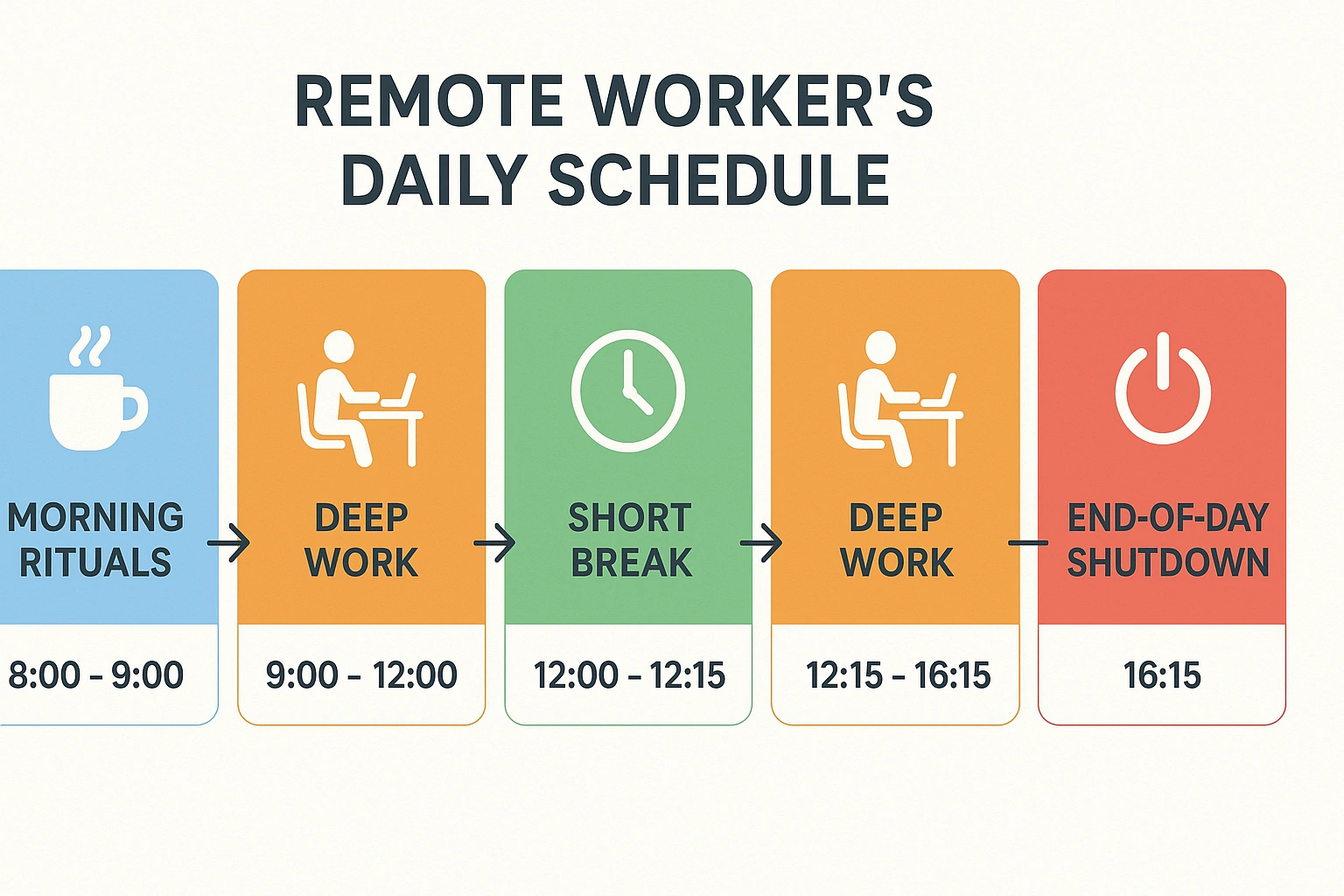
Here’s a simplified process flow illustrating how to create your ideal daily schedule remote worker:
Chart: Remote Work Day Routine Workflow
| Time Block | Activity | Goal | Benefit for Focus/Balance |
|---|---|---|---|
| 7:00 AM – 9:00 AM | Morning Ritual (Exercise, Breakfast, Plan Day) | Energize, prepare mind, set intentions. | Reduces stress, clear mental start to day. |
| 9:00 AM – 12:00 PM | Deep Work Block (High-priority tasks) | Maximize focus & productivity on key deliverables. | Achieve significant progress, less context switching. |
| 12:00 PM – 1:00 PM | Lunch Break & Movement (Walk, Meal) | Physical & mental recharge. | Prevents fatigue, improves digestion, boosts mood. |
| 1:00 PM – 4:00 PM | Communication/Collaboration/Lighter Tasks | Meetings, emails, less intensive work. | Efficient communication, sustained energy. |
| 4:00 PM – 5:00 PM | End-of-Day Ritual (Review, Plan, Shut Down) | Transition from work to personal life. | Clear boundaries, reduces stress, prepares for tomorrow. |
| Total | Balanced & Highly Productive Remote Workday. |
Real-Life Routine Transformation: A Case Study with Remote Routine Tips
Let me share a common scenario that illustrates how implementing effective **remote routine tips** can dramatically improve a remote professional’s focus and work-life balance.
The Challenge:
Maria, a remote marketing specialist, found her workdays unstructured and overwhelming. She’d often roll out of bed and immediately check emails, leading to a reactive start. Her work hours were inconsistent, breaks were rare, and she struggled to disconnect in the evenings, feeling constantly “on” and prone to burnout.
The Transformation with a Remote Work Day Routine:
- Established a Morning Ritual: Maria started waking up at a consistent time, doing a 20-minute yoga session, and having a mindful breakfast before touching her laptop. This created a clear, energizing start to her **remote work day routine**.
- Implemented Deep Work Blocks: She identified her peak focus hours (9:30 AM – 12:30 PM) and scheduled this as a “deep work” block for her most critical tasks (e.g., content creation, strategy). During this time, notifications were silenced.
- Scheduled Breaks & Lunch: Maria put 15-minute breaks on her calendar every 2 hours and a full hour for lunch. She used these breaks to step away from her desk, stretch, or take a short walk outdoors. This was a crucial part of her balanced workday plan.
- Defined an End-of-Day Ritual: At 5 PM, she spent 30 minutes reviewing her accomplishments, planning for the next day, and then physically closed her laptop. She then transitioned to a personal activity, like reading a book or cooking dinner.
Outcome: Within a month, Maria’s productivity soared. She felt more focused during her deep work blocks, less overwhelmed by her inbox, and significantly reduced her back pain. Her energy levels were more consistent, and she found it much easier to disconnect in the evenings, leading to better sleep and a healthier work-life balance. These **remote routine tips** transformed her chaotic remote work life into a structured, fulfilling experience.

Pros and Cons of a Structured Remote Work Routine:
| Pros | Cons |
|---|---|
| Increased Focus & Productivity: Dedicated time for deep work. | Can Feel Restrictive: May take time to adjust to a structured schedule. |
| Better Work-Life Balance: Clear boundaries, prevents overwork. | Requires Discipline: Easy to deviate without external accountability. |
| Reduced Stress & Burnout: Predictability and self-care. | Flexibility Challenges: May be hard to adapt to urgent, unplanned tasks. |
| Enhanced Well-being: Incorporates movement, nutrition, rest. | Initial Setup Time: Requires effort to plan and implement. |
| Improved Accountability: Clear tasks and progress tracking. |
Comparing Approaches to Building a Remote Work Day Routine (2025)
There are various effective strategies for building a **remote work day routine**. Here’s a comparison of popular approaches for a balanced workday plan in 2025.
| Approach | Key Characteristics | Pros | Cons | Best For |
|---|---|---|---|---|
| Time Blocking | Allocating specific time blocks for tasks/activities in a calendar. | High structure, clear focus, reduces context switching. | Can feel rigid, hard to adapt to interruptions. | Users needing strict structure, managing complex projects. |
| Pomodoro Technique | 25-min focused work, 5-min break cycles. | Boosts focus, prevents burnout, good for short bursts of work. | May interrupt deep flow, not ideal for long, uninterrupted tasks. | Individuals struggling with focus, repetitive tasks, students. |
| Theme Days | Dedicate each day to a specific type of work (e.g., “Meeting Monday,” “Writing Wednesday”). | Reduces context switching, allows for deep work on specific areas. | Requires flexibility for urgent tasks, may not suit all roles. | Managers, content creators, roles with diverse responsibilities. |
| Morning/Evening Rituals | Consistent non-work activities to start and end the day. | Creates clear boundaries, improves well-being, reduces stress. | Doesn’t directly structure work hours, needs other methods. | All remote workers, especially those struggling with work-life balance. |
| “Eat the Frog” First | Tackling your most important/difficult task first thing in the morning. | Ensures critical tasks get done, builds momentum, reduces procrastination. | May not align with peak energy for all, requires strong willpower. | Individuals prone to procrastination, high-priority task roles. |
Common Mistakes to Avoid in Your Remote Work Day Routine
While a **remote work day routine** is crucial for success, certain missteps can undermine its effectiveness. Avoid these common pitfalls to truly leverage your remote routine tips.
- Being Too Rigid: Mistake: Creating an overly strict schedule that leaves no room for flexibility or unexpected events, leading to frustration when it breaks. Correction: Build in buffer time. Understand that routines are guides, not unbreakable laws. Be prepared to adapt your daily schedule remote worker when necessary, and get back on track quickly.
- Neglecting Breaks: Mistake: Working for hours straight without stepping away from your desk, leading to fatigue, eye strain, and reduced focus. Correction: Schedule and *take* regular breaks. Use them to move your body, rest your eyes, and mentally disengage. Breaks are essential for sustained productivity and a balanced workday plan.
- Starting the Day Reactively: Mistake: Immediately checking emails or social media first thing in the morning, putting you in a reactive state. Correction: Establish a non-work morning ritual. Dedicate the first hour or two to personal well-being activities before diving into work. This sets a proactive tone for your day.
- Not Having a Clear “Off” Signal: Mistake: Letting work bleed into evenings because there’s no clear transition from work to personal life. Correction: Implement an end-of-day ritual. This could be closing your laptop, tidying your workspace, or going for a walk. This signals to your brain that the workday is over.
- Ignoring Your Peak Productivity Hours: Mistake: Scheduling your most demanding tasks during times when your energy and focus are naturally low. Correction: Identify your peak productivity hours (e.g., morning, late afternoon) and schedule your deep work and high-priority tasks during these times. Use lower energy periods for administrative or less demanding work.
- Working from Your Bed/Sofa: Mistake: Consistently working from comfortable, non-dedicated spaces, blurring boundaries and impacting focus. Correction: Create a dedicated workspace, however small. This physical separation helps your brain associate that space with work, enhancing focus and professionalism.
- Trying to Implement Too Many Changes at Once: Mistake: Overhauling your entire routine overnight, leading to overwhelm and quick abandonment. Correction: Introduce changes gradually. Start with one or two new habits or time blocks, master them, and then slowly add more. Sustainable change is incremental.
Expert Tips & Best Practices for Mastering Your Remote Work Day Routine
To truly optimize your **remote work day routine** and achieve sustained focus and balance, consider these expert strategies and remote routine tips.
- Time Block Your Calendar Religiously: “Treat your focus blocks, breaks, and even personal activities as non-negotiable appointments in your calendar. This visual commitment reinforces your routine,” advises productivity guru, Cal Newport.
- Implement the “Two-Minute Rule”: If a task takes less than two minutes, do it immediately. This prevents small tasks from piling up and disrupting your flow later.
- Plan Your Next Day the Evening Before: Before logging off, spend 15 minutes outlining your top 3 priorities for tomorrow. This reduces morning decision fatigue and ensures a clear start to your daily schedule remote worker.
- Use Technology Wisely: Leverage apps for habit tracking, Pomodoro timers, or distraction blocking to support your routine, rather than letting technology become a distraction itself.
- Schedule “Buffer Time”: Build in 15-30 minute buffer periods between meetings or complex tasks. This allows for unexpected overruns, quick bio-breaks, or a moment to prepare for the next item without feeling rushed.
- Integrate Physical Activity: Don’t just schedule exercise; make it a non-negotiable part of your day. A mid-day walk can be a powerful energy booster and stress reliever for your balanced workday plan.
- Communicate Your Routine: Inform your team and family about your core work hours and deep work blocks. This sets expectations and reduces interruptions, fostering a more respectful work environment.
- Create a “Done For Today” List: Beyond your to-do list, maintain a “done for today” list. Seeing your accomplishments provides a sense of closure and motivation, especially for remote workers.
- Optimize Your Workspace: Ensure your physical environment supports your routine. A clean, organized, and ergonomic workspace minimizes distractions and discomfort.
- Regularly Review & Adapt: Your ideal routine isn’t static. Periodically review what’s working and what isn’t. Be willing to experiment and adapt your routine as your work, life, and energy levels evolve.
Frequently Asked Questions (FAQ) About Remote Work Day Routine
Here are some common questions about creating and maintaining an effective remote work day routine.
Q: Why is a remote work day routine important for focus and balance?
A: A remote work day routine provides structure, reduces decision fatigue, and sets clear boundaries between work and personal life. This consistency enhances focus, boosts productivity, and helps maintain a healthy work-life balance, preventing burnout in a home office setting.
Q: What are the key components of a balanced workday plan for remote workers?
A: Key components include a consistent start and end time, dedicated deep work blocks, scheduled breaks (including a lunch break), time for communication/meetings, and a clear ‘shutdown’ ritual. Incorporating personal well-being activities is also vital.
Q: How can I create a daily schedule as a remote worker?
A: Start by identifying your peak productivity hours. Block out time for high-priority tasks first, then schedule meetings and communications. Don’t forget to include regular breaks, exercise, and a clear end to your workday. Use a digital calendar or planner for consistency.
Q: What are some effective remote routine tips for maintaining focus?
A: Effective remote routine tips include starting your day with a non-work ritual, scheduling deep work blocks, minimizing distractions during focus times, taking regular short breaks, and having a dedicated workspace. Ending your day with a clear shutdown routine also helps.
Q: How do I avoid burnout with a remote work routine?
A: To avoid burnout, ensure your routine includes clear work-life boundaries. Schedule regular breaks, incorporate physical activity, prioritize sleep, and have a consistent end-of-day ritual that signals the transition from work to personal time. Don’t overschedule yourself.
Q: Can a remote work day routine be flexible?
A: Yes, a remote work day routine should be flexible enough to adapt to changing priorities or unexpected events. The goal is structure and consistency, not rigidity. Build in buffer time and be prepared to adjust your daily schedule as needed, while maintaining core habits.
Conclusion
In 2025, a well-defined **remote work day routine** is the cornerstone of success for any remote professional. By meticulously crafting a daily schedule remote worker plan that prioritizes focus, integrates regular breaks, and establishes clear boundaries, you can transform your workday from chaotic to controlled. These remote routine tips empower you to achieve a truly balanced workday plan, boosting your productivity and safeguarding your well-being.
Don’t let the flexibility of remote work lead to an unstructured day. Embrace the power of a consistent routine today, and unlock a new level of focus, efficiency, and harmony in your remote work life!
Ready to take your budget setup to the next level? Explore more advanced tips on maximizing your home office space by visiting
AI Generatif
.
Cheap remote work setup is within reach – go build it!
For cutting-edge insights into remote work trends and best practices, consider reading reports from authoritative sources like Wired Magazine’s remote work productivity section. Master your routine, master your remote work success!