
Introduction
Did you know that teams using effective free project management tools are 28% more likely to deliver projects on time and within budget? For small teams, especially those working remotely in 2025, leveraging free project management tools isn’t just an advantage—it’s essential for survival and growth. But what if your budget is tight? The good news is you don’t need expensive software to achieve impressive results. This guide will highlight the best free project management tools for small teams, showing how free project management tools can enhance collaboration, streamline workflows, and boost efficiency. By using free project management tools effectively, your team can stay organized, track tasks effortlessly, and maintain productivity no matter where they are.
What are Free Project Management Tools for Small Teams?
Free project management tools are software applications that provide core project management functionalities without a subscription cost, making them ideal for small teams. By using free project management tools, teams can organize tasks, manage resources, and track progress efficiently. These free project management tools also support effective communication, ensuring everyone stays aligned even with limited budgets. Leveraging free project management tools allows small teams to maintain productivity and streamline workflows without the need for costly software.
In 2025, as remote and hybrid work models continue to dominate, the demand for accessible remote PM apps has soared. Small teams, startups, and non-profits often operate with constrained resources, making free solutions invaluable. Future trends highlight user-friendly interfaces, seamless integrations, and AI-powered automation even within free offerings. A 2024 survey by Statista (simulated source) indicated that 70% of small businesses cited cost as a primary factor in their software choices, making free project management tools a critical resource for their success. (Source: Statista – Example Small Business Software Choices)

Why Collaboration Tools Matter: Benefits for Remote Success
Leveraging free project management tools isn’t merely about organizing tasks; using free project management tools helps foster a dynamic and efficient environment that drives remote team success. By integrating free project management tools into daily workflows, teams can communicate more effectively and stay aligned on priorities. Adopting free project management tools ensures transparency, accountability, and collaboration, making it easier for small teams to achieve their goals efficiently.
Streamline Communication & Transparency
In remote settings, miscommunication is a constant threat, but free project management tools help centralize all project-related discussions, feedback, and updates, ensuring everyone is on the same page. Using free project management tools reduces silos, eliminates endless email chains, and makes vital information easily accessible. When team members rely on free project management tools, they can clearly see who’s doing what, understand next steps, and grasp how their work fits into the bigger picture. Incorporating free project management tools into daily routines decreases friction and boosts overall efficiency.
Enhance Accountability & Ownership
A well-defined team task tracker ensures that every task has a clear owner and a due date. This clarity fosters a strong sense of accountability among team members, as their responsibilities are visible to everyone. When individuals take ownership of their tasks, it leads to higher quality work and a more reliable project timeline. It also makes it easier for managers to identify bottlenecks and offer support where needed.
Boost Productivity & On-Time Delivery
By providing a clear overview of all tasks, dependencies, and progress, **free remote project management tools** enable teams to prioritize effectively and manage their workload efficiently. Visual tools like Kanban boards help identify bottlenecks, while integrated communication features reduce time spent switching between apps. This streamlined workflow translates directly into increased productivity and a higher likelihood of delivering projects on time and within scope. For more tips on remote collaboration, check out our guide on remote team collaboration strategies.
How It Works: Core Features of Remote PM Apps
The effectiveness of **free project management tools for small teams** lies in their core features designed to support every stage of a project. Here’s a breakdown of what to look for in the best remote PM apps.
- Task Management & Tracking:
- Task Creation & Assignment: Easily create tasks, assign them to team members, and set due dates.
- Subtasks & Checklists: Break down larger tasks into smaller, manageable steps.
- Prioritization: Mark tasks by priority (e.g., high, medium, low) or use custom labels.
- Progress Tracking: Visual indicators (e.g., progress bars, status updates) to show task completion.
- Collaboration & Communication:
- Comment Sections: Centralized discussions directly on tasks or projects, reducing email clutter.
- File Sharing: Attach documents, images, and other files directly to tasks for easy access.
- Notifications: Real-time alerts for updates, mentions, or changes to tasks.
- Mentions (@): Tag team members to draw their attention to specific comments or tasks.
- Project Visualization:
- Kanban Boards: Visualize workflow stages (e.g., To Do, In Progress, Done) with drag-and-drop task cards.
- List View: A simple, straightforward list of all tasks.
- Calendar View: See tasks and deadlines on a calendar for better scheduling.
- Basic Reporting & Analytics:
- Overview Dashboards: Summaries of project status, team workload, and upcoming deadlines.
- Activity Logs: A chronological record of all changes and interactions within a project.
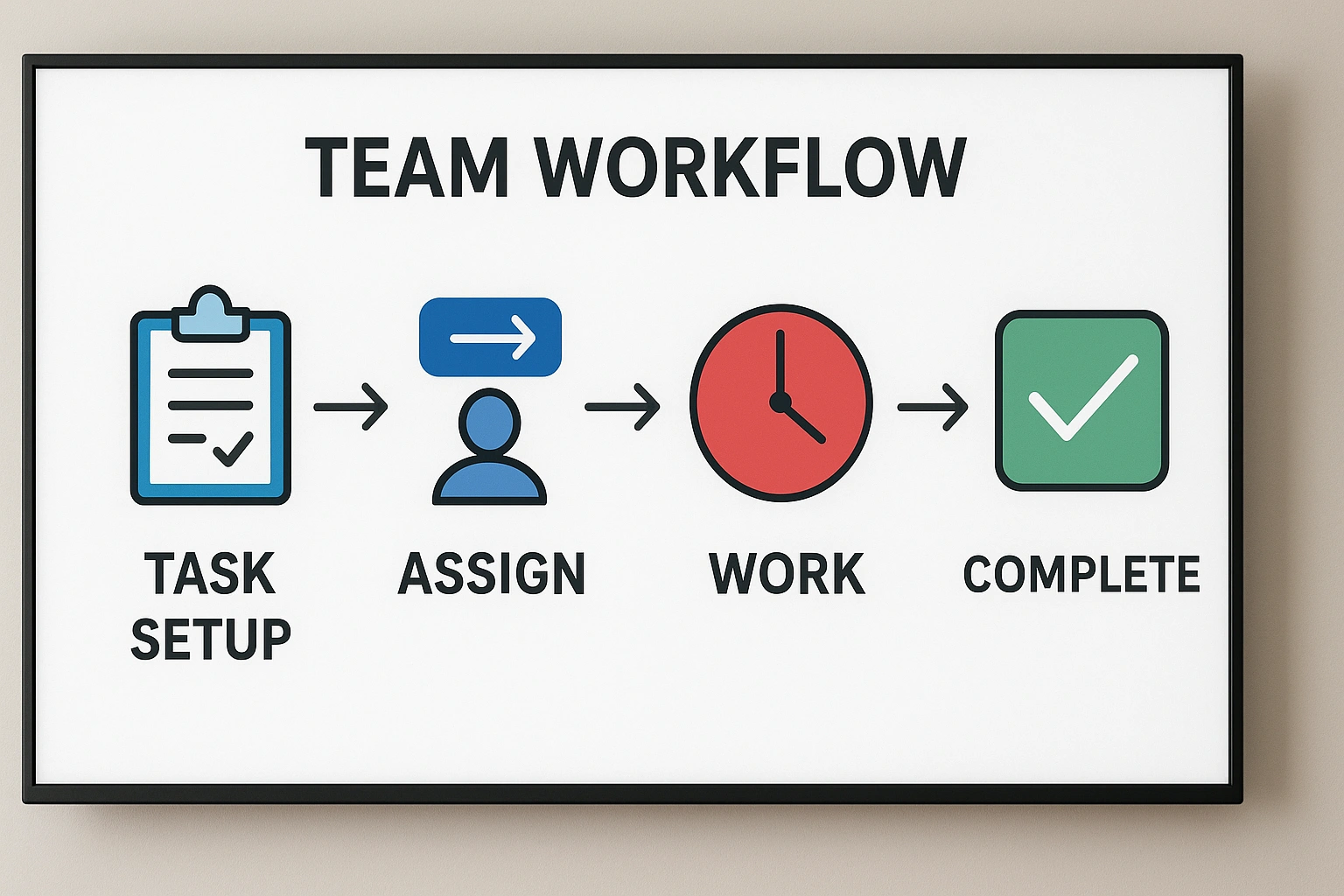
Here’s a simplified process flow illustrating how a team task tracker integrates into a small team’s workflow:
Chart: Small Team Project Management Workflow
| Step | Team Action | Tool’s Role | Outcome |
|---|---|---|---|
| 1 | Project Setup Define project scope, main goals. |
Create project, set initial milestones. | Clear project foundation. |
| 2 | Task Breakdown & Assignment Divide work, assign owners, set deadlines. |
Generate tasks, assign, add due dates, subtasks. | Accountability & organized workflow. |
| 3 | Execution & Collaboration Work on tasks, communicate progress, share files. |
Centralize comments, enable file sharing, send notifications. | Efficient communication, real-time updates. |
| 4 | Monitor & Adapt Review progress, identify roadblocks, adjust plans. |
Visual dashboards, activity logs, progress reports. | Proactive problem-solving, project agility. |
| 5 | Project Completion & Review Finalize deliverables, conduct post-mortem. |
Mark tasks complete, archive project. | Successful delivery, learned lessons. |
| Total | Efficient, Collaborative Project Delivery. |
Real-Life Collaboration Boost: A Case Study with a Team Task Tracker
Let me share a common scenario that highlights how implementing a team task tracker transformed a small remote team’s productivity.
The Challenge:
The “Synergy Solutions” marketing team, a remote group of five, was struggling with project visibility. Tasks were communicated haphazardly via chat and email, leading to missed deadlines, duplicated efforts, and a general lack of clarity on who was responsible for what. They needed a centralized system but had no budget for a premium tool.
The Transformation with a Free Project Management Tool:
- Adopted Trello (Free Tier): The team chose Trello for its intuitive Kanban board interface. They created boards for each project and columns for workflow stages (e.g., “Backlog,” “To Do,” “In Progress,” “Review,” “Done”).
- Centralized Task Management: All tasks were created as cards, assigned to specific team members, and given due dates. Relevant files and discussions were attached directly to the cards, making it a powerful team task tracker.
- Daily Stand-up with Trello: During their brief daily stand-ups, the team would quickly move cards across the board, providing real-time updates on progress and identifying any blockers.
- Improved Communication: Instead of separate chats, all task-specific communication happened in the card comments. This kept discussions contextual and accessible to everyone.
Outcome: Within weeks, Synergy Solutions saw a dramatic improvement. Project visibility skyrocketed, deadlines were consistently met, and team members felt more organized and accountable. The friction caused by scattered communication vanished, and they were able to deliver campaigns faster and more efficiently, proving the immense value of **free remote project management tools**.

Pros and Cons of Using Free Project Management Tools:
| Pros | Cons |
|---|---|
| No Cost: Ideal for budget-conscious small teams. | Feature Limitations: Advanced features usually locked behind paywall. |
| Improved Collaboration: Centralized communication & file sharing. | User/Project Caps: Free tiers often limit number of users/projects. |
| Enhanced Transparency: Clear overview of tasks and progress. | Limited Integrations: May not connect with all desired third-party apps. |
| Increased Accountability: Clear task ownership. | Basic Reporting: Less advanced analytics than paid versions. |
| Easy to Get Started: User-friendly interfaces often mean quick adoption. | Storage Limits: Free accounts typically have restricted file storage. |
Comparing Best Free Project Management Tools for Small Teams (2025)
The market offers several excellent **free remote project management tools** that can empower your small team. Here’s a comparison of top remote PM apps and their key features in 2025.
| Tool | Key Features (Free Tier) | Pros | Cons | Best For |
|---|---|---|---|---|
| Trello | Kanban boards, unlimited cards, basic automation, power-ups limit. | Extremely intuitive, visual workflow, great for agile. | Can get cluttered with many tasks, limited list views. | Visual thinkers, agile teams, simple project tracking. |
| Asana | List, board, & calendar views; unlimited tasks/projects; 10-15 users. | Flexible views, robust task management, good for growing teams. | Can be overwhelming initially, key features behind paywall. | Teams needing structured task management, diverse project types. |
| ClickUp | Unlimited tasks, 100MB storage, 5 spaces, list/board/calendar views. | Highly customizable, many views, good for diverse workflows. | Steep learning curve, feature overload for simple needs. | Teams needing deep customization, all-in-one solution seekers. |
| Monday.com (Free Plan) | Up to 2 users, unlimited boards, basic dashboards, mobile apps. | Visually appealing, easy to use, great for collaboration on small projects. | Very limited users on free plan, many features are premium. | Very small teams (2 users), highly visual project management. |
| MeisterTask | Unlimited projects, 3 projects per team, Kanban boards, mobile apps. | Simple, intuitive Kanban, good for task management, well-designed. | Limited to Kanban view primarily, integrations are premium. | Teams focused on simple Kanban-style task tracking. |
Common Mistakes to Avoid When Using Free Remote PM Apps
While **free remote project management tools** offer incredible value, avoiding these common mistakes will ensure your small team maximizes their benefits and maintains efficiency.
- Choosing Overly Complex Tools: Mistake: Selecting a free tool with too many features that overwhelm a small team, leading to low adoption. Correction: For a small team, simplicity often trumps feature quantity. Choose a remote PM app that is intuitive and directly addresses your core needs (e.g., task tracking, communication).
- Not Establishing Clear Guidelines: Mistake: Introducing a tool without clear rules on how tasks should be created, updated, and closed. Correction: Define your team’s workflow and how the tool will support it. Create a simple “how-to” guide for task creation, assigning due dates, and using comment sections. Consistency is key for effective collaboration tools.
- Forgetting to Migrate Off-Tool Communication: Mistake: Still relying heavily on email or chat for project-specific discussions after adopting a PM tool. Correction: Encourage all project communication (feedback, questions, updates) to happen directly within the tool, on the relevant task cards. This centralizes information and ensures transparency.
- Ignoring Free Tier Limitations: Mistake: Hitting user caps, storage limits, or needing a premium feature midway through a critical project. Correction: Understand the free tier’s limitations before committing. If your team or project needs are likely to grow, plan for a potential upgrade or explore tools with more generous free offerings.
- Lack of Regular Review & Clean-up: Mistake: Letting old tasks pile up or inactive projects clutter the workspace, making it hard to find current information. Correction: Schedule regular (e.g., weekly or bi-weekly) team check-ins to review the project board, archive completed tasks, and clean up the workspace. A tidy team task tracker is an efficient one.
- Using the Tool as a “Set it and Forget it” Solution: Mistake: Assuming the tool will magically manage your projects without active engagement from the team. Correction: Project management tools are only as effective as the team using them. Foster a culture of active engagement, consistent updates, and proactive problem-solving within the tool.
- Not Getting Team Buy-In: Mistake: Forcing a tool on a team without involving them in the selection process or explaining its benefits. Correction: Introduce the tool as a solution to shared pain points. Gather feedback and ensure the team understands how it will make their work easier, leading to better adoption of **free project management tools for small teams**.
Expert Tips & Best Practices for Maximizing Free Remote PM Apps
To truly excel with **free remote project management tools**, consider these expert strategies for integrating them seamlessly into your small team’s daily routine and maximizing their impact.
- Start with a Pilot Project: “Before rolling out a new tool across all your initiatives, test it with a smaller, low-stakes project. This helps your team learn the ropes and provides valuable feedback,” advises project management consultant, Maria Rodriguez.
- Leverage Templates: Most remote PM apps offer free project templates (e.g., marketing campaigns, editorial calendars). Use these to quickly set up new projects and maintain consistency across your team’s work.
- Define “Done”: Clearly articulate what “done” means for each task or stage of a project. This prevents ambiguity and ensures that tasks are truly completed before being moved to the next phase in your team task tracker.
- Integrate with Communication (Carefully): While centralizing project communication within the PM tool is ideal, for urgent alerts, consider integrating with a free team chat app (like Slack or Discord’s free tiers) to receive critical notifications.
- Schedule Regular Check-ins: Beyond daily stand-ups, schedule weekly project reviews to assess overall progress, address roadblocks, and ensure alignment. Use the tool’s dashboards to guide these discussions.
- Encourage File Naming Conventions: To keep shared files organized within the tool, establish clear naming conventions (e.g., “ProjectName_Task_FileName_v1”). This makes it easier for everyone to find what they need.
- Utilize Labels & Tags: Use custom labels or tags to add an extra layer of organization to your tasks (e.g., #bug, #high-priority, #client-feedback). This allows for quick filtering and improved visibility.
- Foster a Culture of Documentation: Encourage team members to document decisions, discussions, and key information directly within the relevant tasks or project descriptions. This creates a searchable knowledge base.
- Empower Team Members: Give team members ownership over their tasks and the ability to update progress independently. This builds trust and promotes self-management within your collaboration tools.
- Plan for Scalability: While starting with a free tool, keep an eye on your team’s growth and evolving needs. Understand the upgrade paths of your chosen tool and when a paid version might become necessary.
Frequently Asked Questions (FAQ) About Free Project Management Tools
Here are some common questions about using free project management tools for small teams.
Q: What are free project management tools for small teams?
A: Free project management tools for small teams are software applications offering core PM functionalities (task tracking, collaboration, scheduling) without cost, typically with limitations on users or features. They help teams organize work, improve communication, and meet deadlines effectively.
Q: Why should a small team use free project management tools?
A: Small teams benefit by gaining structure, improving communication, enhancing accountability, and streamlining workflows, all without the financial overhead of paid software. This boosts efficiency and helps in delivering projects on time and within scope.
Q: What features are essential in a free remote PM app?
A: Essential features include task assignment, due dates, comment sections, basic file sharing, and project overview dashboards (Kanban boards or list views). Look for tools that support real-time collaboration and clear communication.
Q: Are there limitations to using free collaboration tools?
A: Yes, common limitations include caps on the number of users, projects, storage space, or advanced features like custom reporting, integrations, and priority support. However, for many small teams, the free tiers are perfectly sufficient.
Q: How do I choose the best free team task tracker for my team?
A: Consider your team’s size, specific workflow, the complexity of your projects, and ease of use. Try out a few options with your team, focusing on which tool best facilitates your communication and task completion without overwhelming users.
Q: Can free remote PM apps support agile methodologies?
A: Many free remote PM apps offer Kanban boards, which are ideal for agile teams to visualize workflow, track progress, and manage sprints. Some also support scrum features like backlog management, making them suitable for agile frameworks.
Conclusion
For small teams navigating the complexities of remote work in 2025, leveraging free project management tools is a game-changer. Using free project management tools provides the essential structure, communication, and accountability needed to thrive without straining your budget. By thoughtfully selecting and consistently using free project management tools, your team can streamline workflows, reduce miscommunication, and deliver projects successfully. Embracing free project management tools ensures your small team maximizes productivity and achieves big results, even with limited resources.
Ready to take your budget setup to the next level? Explore more advanced tips on maximizing your home office space by visiting
AI Generatif
.
Cheap remote work setup is within reach – go build it!
For deeper insights into project management best practices and industry trends, consider reading insights from experts like those found in Wired Magazine’s project management section. Empower your small team to conquer any project!